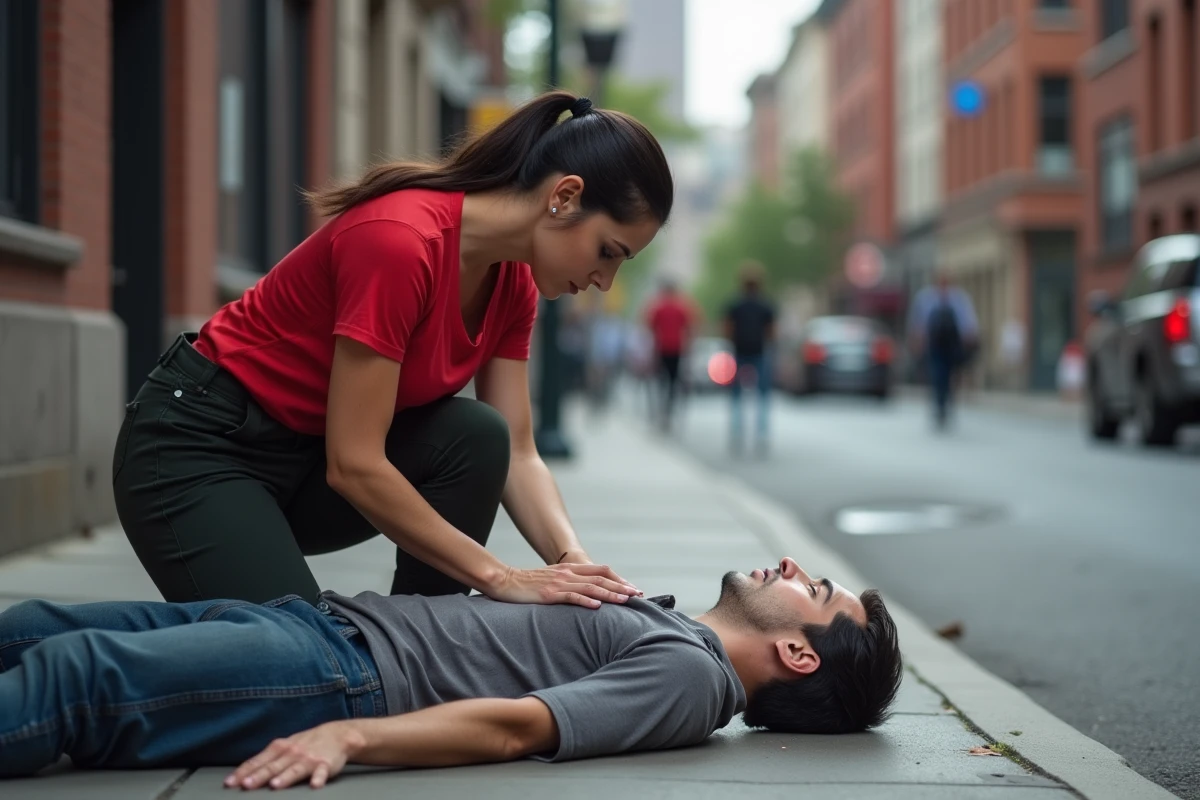
In the face of cardiac arrest, the survival rate in France remains low, partly because the time between the incident and the first rescue action is often too long. The three Ps (protect, prevent, rescue) structure the emergency response into three sequential steps, each affecting the effectiveness of the next. Measuring the impact of each step on the prognosis of a victim helps to understand why some are systematically neglected, and at what cost.
Protect, prevent, rescue: what each P entails concretely
The three Ps are not equal in terms of time or required skill. The table below compares their operational characteristics for a non-professional witness.
| Step | Main Action | Average Duration | Required Skill |
|---|---|---|---|
| Protect | Remove or isolate the danger (traffic, electricity, fire) | Few seconds | Observation, common sense |
| Prevent (alert) | Call 15, 18, or 112, provide an assessment | 1 to 3 minutes | Ability to describe the situation and the victim’s condition |
| Rescue | Cardiac massage, recovery position, hemorrhage compression | Until help arrives | GQS or PSC1 training |
The protection phase is the quickest, but also the most often rushed. A secondary accident (a second vehicle hitting the scene, a rescuer getting electrocuted) nullifies the entire rescue chain. This is why establishing a safety perimeter, even a basic one, precedes any other action.
The alert phase conditions the intervention time of professionals. Providing a precise assessment (victim conscious or not, breathing present or absent) allows the SAMU dispatcher to send the appropriate resources. A vague description prolongs the decision-making time.
Knowing where to find the rescue gestures to remember helps to anchor these reflexes before facing a real emergency.

Cardiac massage and defibrillator: the link that changes the prognosis
Rescue, the third P, concentrates the vital issue. In the event of cardiac arrest, every minute without massage reduces the chances of survival. External cardiac massage maintains minimal blood circulation to the brain while waiting for defibrillation.
The technical gesture is accessible after short training. It involves compressing the sternum by about five centimeters, at a rate of 100 to 120 compressions per minute, on a victim lying on a hard surface. Two elements make the difference:
- The depth and regularity of compressions matter more than mouth-to-mouth, which can be omitted by an untrained witness according to current recommendations
- The use of an automated external defibrillator (AED), present in many public places, multiplies the chances of restoring cardiac activity when applied in the first few minutes
- The relay between witnesses (alternating every two minutes) maintains the quality of compressions, as fatigue quickly degrades the gesture
In France, the distribution of AEDs in train stations, shopping centers, and town halls has progressed. However, their location is often poorly signposted, which delays their use by witnesses.
Citizen alert applications: the relay before professional help
Applications like SauvLife geolocate citizens trained in life-saving gestures and alert them in case of cardiac arrest nearby. This system, deployed in several departments in connection with SAMU, aims to reduce the critical delay between the call and the first massage.
The principle relies on a network of volunteer responders. When the 15 center receives a call for cardiac arrest, the application notifies trained citizens located within a close radius. The first to arrive begins cardiac massage, sometimes several minutes before the ambulance.
This model raises a question of ongoing training. A citizen responder must keep their skills up to date for the gesture to be effective under stress. Express training such as “life-saving gestures” (GQS), offered during events in town halls or companies over one to three days, partially meets this need. They reach an audience that does not spontaneously enroll in PSC1 (Civic Prevention and Rescue Level 1), which is longer and more comprehensive.
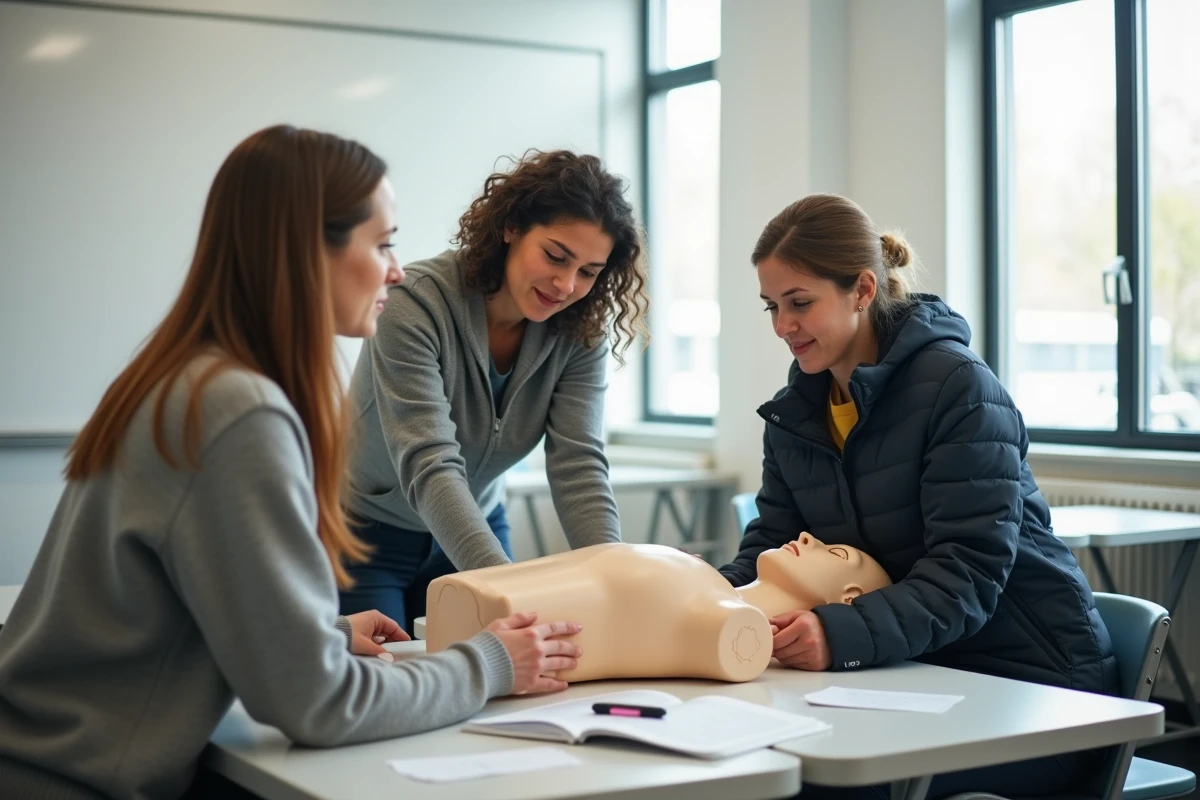
First aid training in the workplace: SST obligation and ground reality
In the professional environment, the workplace first aid responder (SST) training incorporates the three Ps within a regulatory framework. The employer must have a sufficient number of trained employees, adapted to the size of the company and the risks identified in the single risk assessment document.
The SST learns to protect, alert, and intervene in the specific context of their position. An employee in a logistics warehouse does not face the same dangers as an office worker. The training therefore includes an analysis of the specific risks of the site: machines, chemicals, working at heights.
Prevention, the second P often reduced to phone alert, takes on an expanded meaning here. The SST participates in accident prevention by reporting dangerous situations and contributing to the updating of the first aid kit. The first aid kit must be checked and restocked regularly, a point neglected in many organizations.
GQS, PSC1, or SST: which training to choose
| Training | Duration | Target Audience | Certification |
|---|---|---|---|
| GQS (life-saving gestures) | 2 hours | General public | Certificate |
| PSC1 | 7 hours | General public | Competency certificate |
| SST | 14 hours (+ recertification) | Employees | SST certificate valid for 24 months |
The choice depends on the context. GQS is sufficient to acquire basic reflexes in a few hours. PSC1 deepens each gesture with varied practical scenarios. SST remains the only training that links first aid and professional risk prevention.
The sequence protect, prevent, rescue acts as a filter: each poorly executed step degrades the next. Rushed protection exposes the rescuer, imprecise alert delays professionals, and poorly mastered technical gestures lose their effectiveness. Mastering the three Ps, even at a basic level, remains the most direct way to change the prognosis of a victim before help arrives.