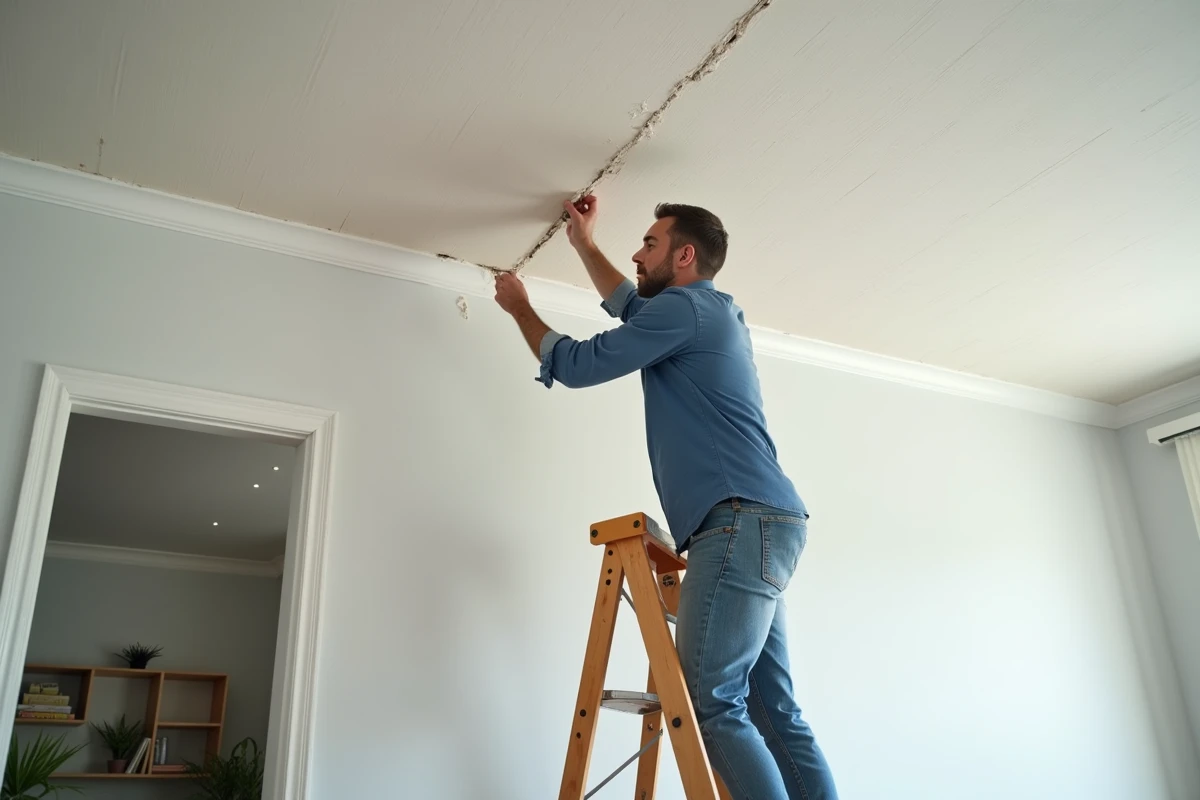
Claiming that a drywall ceiling can support anything is a risky bet. The numbers are there: the resistance depends on a range of parameters that the manuals often overlook, and the slightest discrepancy between theory and actual site conditions can be costly.
The plasterboard panels screwed to the ceiling are not designed to bear heavy loads. The DTU 25.41 standard precisely regulates the permissible load based on the type of fastening, the thickness of the panels, and the strength of the structure supporting them.
Yet, a gap exists between the performance claimed by manufacturers and what is observed on the ground. If a metal or wooden frame is slightly undersized, or if the anchors are not suitable, the risk of tearing becomes very real. A simple neglected calculation, a hasty installation, and the entire ceiling may be at risk of collapsing.
Understanding the structure of a drywall ceiling and its physical limits
The principle of a drywall ceiling relies on a metal frame made of tracks and hangers. These elements, anchored in the framework or the upper floor, form the structure that supports the plasterboard panels. Every detail matters: how the panels are screwed, the quality of the hangers, the junction with the building structure… Everything influences the overall resistance. This system, known for its lightness and ease of installation, quickly shows its limits as the load increases.
To know what weight a drywall ceiling can support, one must examine the nature of the materials used: thickness of the plaster, spacing of the hangers, robustness of the tracks… The DTU 25.41 standard defines strict requirements, but in renovations, discrepancies are not uncommon, especially if the original joists are outdated or do not meet current standards. On a compliant and properly installed frame, a drywall ceiling will rarely support more than 3 to 6 kg per anchoring point, depending on the anchor used and the quality of the structure.
Two types of panels are generally distinguished, suited for different uses:
- Standard panel: designed for modest loads like a small light fixture, a detector, or a lightweight decorative object.
- Reinforced thickness: for more demanding uses, provided the overall strength of the frame is verified.
A direct fastening in the plasterboard limits resistance. It is better to distribute the load across the metal frame. The true limits of the system come less from the plaster itself than from the quality of the assembly between the frame, hangers, and joists. If you want to delve deeper into the subject, the page “maximum load of a drywall ceiling: what you need to know” details all these points.
What factors truly influence the load capacity of a plasterboard ceiling?
The load capacity of a drywall ceiling never depends on a single parameter. Several intertwined factors are all crucial. The supporting structure, whether it consists of joists, beams, or a metal frame, forms the foundation of resistance. If it is undersized or too widely spaced, it will give way well before the panel itself, even if the panel appears intact.
The load distribution also matters. A small object suspended from a single fixing point will not stress the structure like a load spread over multiple points. The type of fastening then makes all the difference: a metal expansion anchor, a through screw anchored in a track, or a simple fastening in the plaster do not provide the same hold.
Parameters to closely examine
Here are the main criteria to consider when estimating load capacity:
- Type of panel: standard, moisture-resistant, or reinforced, each with its uses.
- Quality of the frame: section of the tracks, spacing of the hangers, density of the framework.
- Weight of the objects to be suspended: clearly define the load to be distributed and do not exceed the limit per fixing point.
A compliant installation determines the ceiling’s resistance. If each element, screws, tracks, hangers, panels, is well chosen and properly installed, the structure will hold without fail. Never underestimate the maximum load supported by each component. Ignoring the limits or taking liberties with the standard exposes one to sudden failures, sometimes spectacular.

Practical tips for securing the installation of heavy objects and avoiding risks
Fixing a heavy object to a drywall ceiling is not something to improvise. Start by identifying the frame: a well-sized metal structure inspires confidence, unlike a poorly assembled or uncertainly sourced arrangement of tracks. The hangers must be suitable and securely fixed in the slab or joists; this is the basis for hoping to hang a significant weight.
To install a massive light fixture, a hanging plant, or any other heavy element, turn to metal expansion anchors (like Molly) or spring segments. These solutions distribute the load over a larger surface and minimize the risk of the panel giving way. For objects exceeding 10 kg, a threaded rod passing through the drywall and anchored directly into the supporting structure offers the best security.
Points to check before installation
Before you begin, systematically check the following elements:
- Precisely locate the position of the metal tracks or joists to avoid fixing in a hollow area.
- Adapt the type of anchor to the weight to be suspended: each model has its own limit.
- Respect the spacing between fixing points to properly distribute the load across the ceiling.
As soon as the intended load approaches the limits supported by the drywall, it is better to call in a professional. Attempting the experience without expertise exposes one to material damage and sometimes to injuries. It’s better to prioritize safety, especially when it comes to the invisible structure of one’s home.
A drywall ceiling is a delicate balance between precautions, calculations, and technique. Pulling too hard on the cord, and the entire setup may wobble. Stay vigilant: the weight of suspended objects is never a detail, and gravity never gives a break.