
Since the end of 2023, China has gradually opened its doors to French nationals without a visa requirement for short stays. This arrangement, extended until December 31, 2026, changes the game for travelers, but does not cover all scenarios. Between exemption, visa-free transit, and standard application, the rules vary depending on the duration, purpose of stay, and the itinerary taken.
Visa-free transit in China: the trap of flight delays
Visa-free transit (144 hours in certain Chinese cities) attracts many French travelers in transit. The principle is simple: you cross China between two third countries, without exceeding the authorized duration or leaving the defined geographical area.
The problem arises when a flight is delayed or canceled. A traveler whose connection exceeds the planned transit window may find themselves in violation, with no immediate recourse. Chinese authorities strictly enforce the time limit, and an overstay, even if unintentional, can lead to deportation or administrative detention.
To understand how to obtain a visa for China and avoid this type of situation, one must first recognize the fragility of visa-free transit in the face of air travel uncertainties.
Standard travel insurance does not cover the administrative consequences of exceeding transit limits. They cover rebooking or accommodation, but not consular fees or immigration penalties. Planning for a time buffer of at least six hours between landing and the transit limit remains the only reliable precaution. For layovers with tight connections, applying for a standard visa before departure eliminates the risk.

Visa exemption for France: conditions and limits until 2026
Until December 31, 2026, holders of a French ordinary passport can enter mainland China without a visa for a maximum duration of 30 days. Authorized purposes include tourism, business, family visits, exchange visits, and transit.
Any other reason for stay, such as work, studies, or an internship, remains subject to the visa requirement. Holders of emergency passports (valid for one year) or service passports are excluded from this arrangement.
- The stay cannot exceed 30 days, with no possibility of extension on-site under this exemption regime.
- The declared purpose upon arrival must match exactly the authorized categories, under penalty of refusal of entry.
- A passport valid for at least six months after the planned entry date is required by most airlines, even if Chinese regulations do not always explicitly set this threshold.
A poorly declared purpose of visit exposes one to a refusal of admission to Chinese territory, according to the French Ministry of Foreign Affairs. The line between “tourism” and “business prospecting” may seem blurred, but immigration officers regularly ask questions about the precise purpose of the stay.
Standard Chinese visa: when application remains mandatory
For a stay longer than 30 days, or for any reason not covered by the exemption, applying for a visa remains the only option. The procedure goes through the Visa Center for China (Visaforchina), located in Neuilly-sur-Seine, which is mandated by the Chinese embassy.
Types of visa according to the purpose of stay
The L visa pertains to tourism. The X visa is for students, with a distinction between X1 (long stay) and X2 (short stay). The Z visa is reserved for workers with a contract and work authorization. The Q visa allows for family reunification with a Chinese national.
Each visa category requires specific documents: invitation letter, accommodation certificate, financial proofs, or medical certificate depending on the case. The application must be uploaded to the official website of the Visa Center before physical submission.
Processing times and points of caution
Processing times vary, but expect at least a week during off-peak periods. In high tourist season, reports from the field differ on this point: some travelers report delays well beyond that. Submitting your application at least three weeks before departure reduces stress.
The online form from the Visa Center is lengthy and technical. An error in dates, accommodation addresses, or travel history can lead to rejection of the application. Filling in each field with the exact information from the flight ticket and hotel reservation avoids back-and-forth.
Increase in visa-free entries: what recent figures reveal
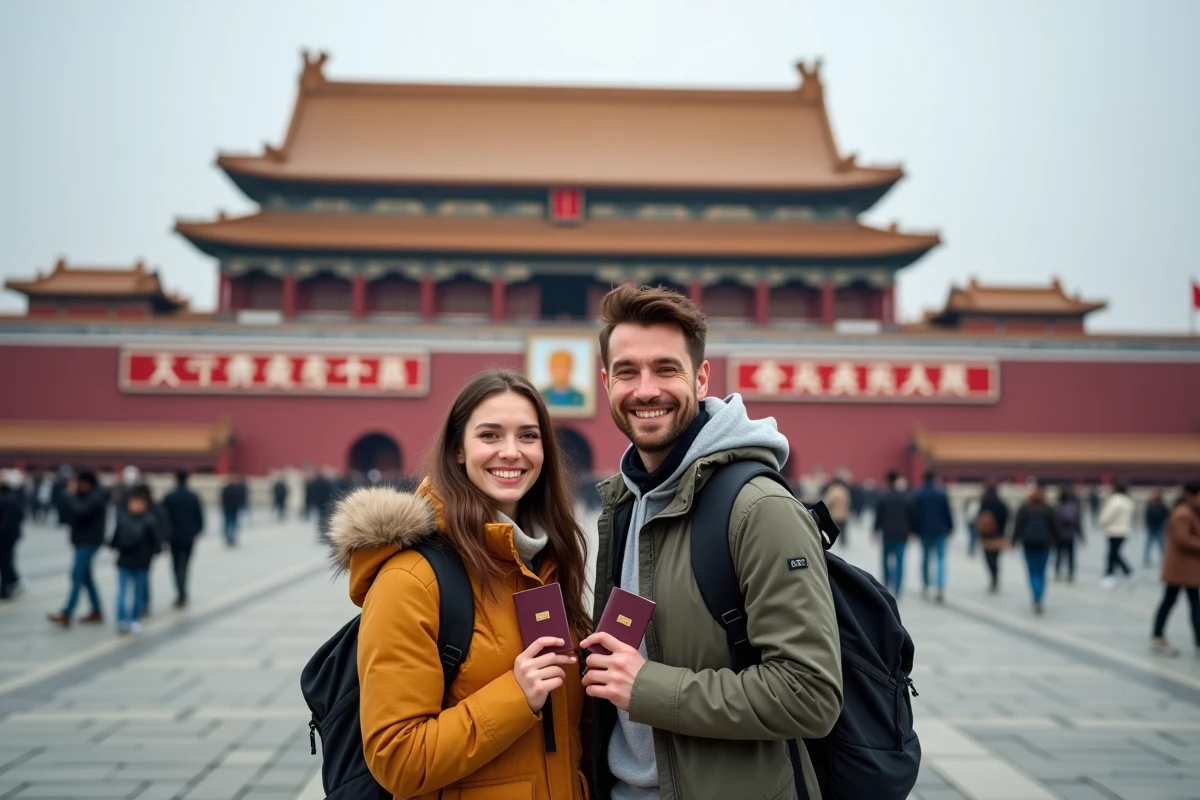
During the May 1, 2026 holidays, visa-free arrivals in China increased by 147% compared to the previous year, according to VisaHQ. This increase reflects the direct effect of the extension of the exemption scheme, which now includes the United Kingdom and Canada in addition to already covered countries.
For French travelers, this increase in traffic has a concrete impact: immigration lines at major Chinese airports are getting longer. The counters dedicated to visa-free arrivals are not always sized to handle the flow, especially in Beijing and Shanghai during Chinese holiday periods.
The available data does not allow for conclusions on whether this trend will continue beyond 2026. The exemption scheme remains a measure that Chinese authorities can adjust or suspend without notice. Traveling with a valid standard visa remains the most solid guarantee for a stay without unpleasant surprises, regardless of the evolution of Chinese immigration policy.
For a stay of less than 30 days for tourism purposes, the exemption works. For everything else, applying for a standard visa, despite its administrative burden, remains the only framework that protects the traveler in case of unforeseen events, changes in plans, or enhanced checks upon arrival.