Family dynamics vary according to the composition of the household, the ages of its members, the degree of geographical distance, and sometimes the presence of old tensions. This complexity makes some ready-made recipes ineffective, or even counterproductive.
Family rituals: when regularity is not enough
Most online guides recommend establishing rituals: shared meals, Sunday outings, board games. These practices have a solid foundation. The regularity of a shared moment creates a predictable framework, and this predictability is particularly reassuring for children.
The problem arises when the ritual becomes a meaningless obligation. A daily family meal where each member stares at their plate in silence produces no cohesion. The quality of interaction matters more than the frequency of the ritual. A twenty-minute exchange where everyone shares a significant moment from their day has more impact than an hour of passive cohabitation in front of a screen.
Blended families illustrate this limit well. Imposing a ritual inherited from a previous family configuration can generate rejection from a child or teenager who did not participate in its creation. To find ideas suitable for different family profiles, one can browse the family page of Vraiment Sympa, which offers various activities based on ages and interests.
Field feedback varies on this point: some family mediation professionals report that imposed rituals can crystallize conflicts in already tense households. It is better to build a ritual with the concerned members than to impose an external model.

Family communication: beyond the injunction to “talk better”
“Communicate more” is the most frequent and least actionable advice. Telling overwhelmed parents or a withdrawn teenager that there needs to be “more dialogue” is like prescribing walking to someone with a sprained ankle without offering crutches.
Family communication relies on concrete material conditions. A household where work schedules allow only thirty minutes of co-presence per day does not have the same levers as a household with free weekends. Before discussing the quality of exchange, it is essential to identify the time slots that are genuinely available.
Often ignored prerequisites
- A shared physical space without distractions: a kitchen table cleared of screens and ongoing administrative tasks works better than a living room with the television on in the background
- A minimal emotional availability: engaging in an important conversation after an exhausting day rarely produces a quality exchange. Identifying the moment when each member is most receptive changes the game
- The acceptance that some members communicate differently than through speech: a child drawing what they feel or a teenager sending a text message instead of talking face-to-face uses a different, not inferior, channel
Adapting the communication channel to each family member is not a concession. It is a form of respect for individual modes of expression.
Shared tasks and household organization as a lever for cohesion
Leisure activities capture all the attention in family guides. Daily life, however, consists of grocery shopping, cleaning, meal preparation, and managing medical appointments. These tasks represent the majority of the time spent together in a household. Ignoring them means missing the primary ground for connection.
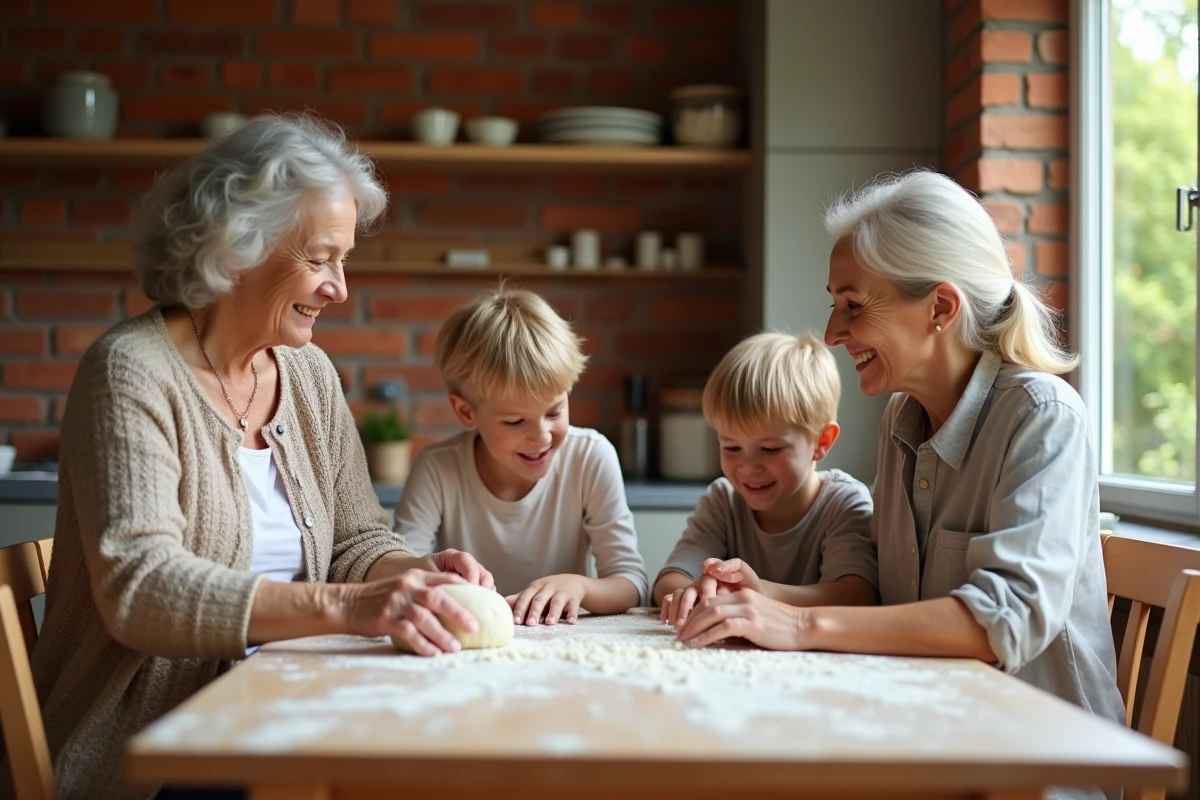
A child who participates in meal preparation does not just learn to cook. They observe how a parent manages time, makes choices, and improvises when an ingredient is missing. Ordinary moments build family memory just as much as vacations do.
Task distribution and sense of belonging
The distribution of tasks among household members directly influences the sense of fairness. When one parent assumes the mental load of domestic organization, the imbalance generates resentment that erodes the relationship. Children perceive this asymmetry sooner than one might think.
Involving each member in a responsibility suited to their age creates a sense of contribution. A five-year-old who sets the table every evening occupies a visible place in the functioning of the household. This concrete role reinforces their belonging to the family group much more effectively than a speech about the importance of family.
Screens and family bonds: a coexistence to arbitrate, not to prohibit
The effect of screens on family interactions is a recurring topic of debate. No study cited here sets a threshold of screen time beyond which bonds deteriorate. However, the context of use seems to be decisive.
A phone checked during a family meal sends a clear signal of disengagement. The same phone used for a video call with a distant grandparent strengthens the intergenerational bond. The screen is neither ally nor enemy; it is its use that matters.
- Family messaging groups (WhatsApp, Signal) allow for maintaining a daily conversation thread among geographically distant members, including connected grandparents
- Cooperative video games played together provide a ground for exchange between parents and teenagers, provided that the game is chosen jointly
- Shared online photo albums create a collective memory accessible to all members, including those who live far away
Setting rigid rules (“no screens before a certain age,” “never at the table”) works in some households and fails in others. Families that negotiate these rules together respect them better than those where they are unilaterally imposed by one parent.
Each household operates with its own constraints of time, space, and composition. Adjustments that hold over time are those that members build together, based on their real daily life, not on a theoretical model.