
When booking a hot air balloon ride, the first practical question the operator asks is each passenger’s weight. This information determines how the basket is configured, how much gas is needed and, ultimately, whether the flight can go ahead. Understanding how the total payload affects the flight helps avoid any unwelcome surprises on the day.
Hot air balloon payload: what’s at stake before takeoff
It’s easy to assume that the weight limit applies only to passengers. In reality, the total weight includes the pilot, passengers, fuel (the propane cylinders), onboard instruments and any other items carried in the basket.
Each balloon has a maximum permitted weight, listed in its flight documents or on a plate visible to the pilot. This figure is specific to the aircraft: it depends on the envelope’s volume, the strength of the suspension cables and the basket’s structure. As a result, two hot air balloons operated by the same company may have different limits.
When looking into the maximum weight allowed on a hot air balloon, you’ll find that there is no universal standard setting a single limit per passenger. The figure quoted by an operator (often around 110 to 150 kg per person, depending on the French company) is based on calculations specific to its equipment and operating conditions.
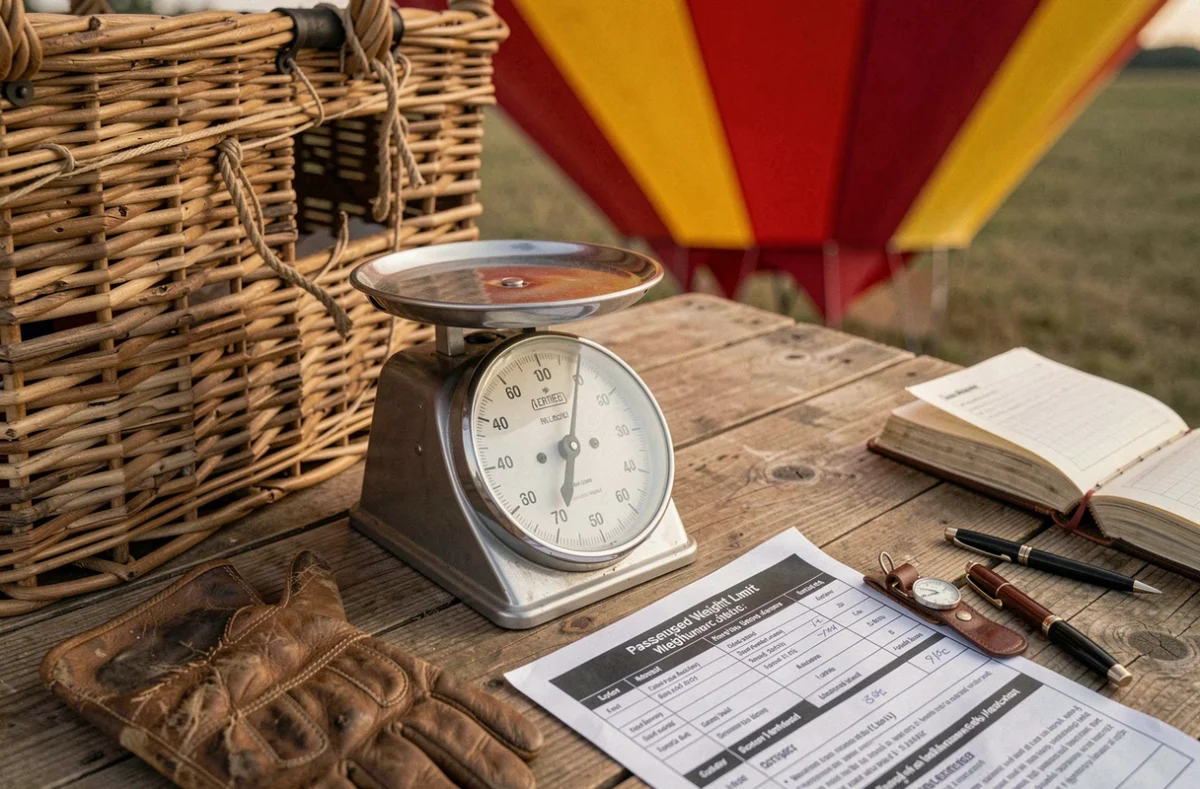
Passenger weight limits for hot air balloon rides: what operators typically allow
Most French companies set an individual limit of between 110 and 150 kg. Some charge an additional fee above a certain threshold—for example, one operator in the Auvergne region charges 75 euros for passengers weighing 110 kg or more. This extra cost covers adjustments to the flight, such as carrying fewer passengers in the basket and increasing the amount of propane.
The pilot doesn’t simply check the declared weight. They assess the basket’s total load for that specific flight. If the weather is unfavorable (high temperatures, humidity or the altitude of the launch site), the envelope’s lifting capacity decreases, and the number of passengers allowed may be reduced—even if each passenger is individually within the stated limit.
Why companies ask for your exact weight when you book
Declaring your weight is not just an administrative formality. It helps the pilot plan the total payload, calculate the amount of propane needed and distribute passengers throughout the basket to ensure balance during takeoff and landing.
Underestimating your weight when booking may result in your flight being canceled on the day. Operators sometimes check that the declared weight is accurate—not out of curiosity, but because exceeding the payload limit puts flight safety at risk.
Altitude, temperature and wind: factors that affect payload capacity
A hot air balloon flies because of the difference in density between the hot air inside the envelope and the surrounding air. Three on-site conditions directly affect lift, and therefore the weight the balloon can carry.
- Ground temperature: in hot weather, the outside air is less dense, reducing the difference in density and lowering lift. A flight scheduled for late morning in summer often requires fewer passengers than one taking off at sunrise.
- Launch-site altitude: the higher the terrain, the thinner the air. A hot air balloon operating in the mountains has a lower payload capacity than the same balloon taking off from a lowland area.
- Wind and humidity: high humidity affects air density. Wind does not directly affect lift, but it influences the safety of takeoff and landing and may lead the pilot to reduce the basket’s load to maintain a safety margin.
That’s why the pilot always makes the final decision about whether the flight can go ahead on the morning of the flight, after checking the weather conditions. A flight confirmed the day before may be postponed, or the basket’s passenger configuration may be changed at the last minute.

Basket safety: structural limits and the pilot’s role
Certification regulations for manned balloons set strength requirements for the envelope, the attachments connecting it to the basket and the basket structure itself. They also require operators to prevent passengers, luggage or other items from interfering with the flight controls.
In practice, before each flight the pilot checks that the basket is not over its maximum load and that the weight is evenly distributed. An unbalanced basket makes takeoff more difficult to manage and increases the risks during landing, when the basket takes an impact as it touches the ground.
What the pilot checks on the day of the flight
- The total weight on board (passengers, crew, propane and equipment)
- How passengers are distributed among the basket compartments to maintain balance
- The condition of the attachments between the envelope and the basket, which must support the declared load
- Local weather conditions, which may affect the permitted load
Passengers with reduced mobility or anyone who may have difficulty standing for the entire flight (usually one hour in the air) should let the operator know in advance. The basket has no seats or seat belts: every passenger must be able to stand and hold on to the handles during landing.
Medical restrictions and special cases related to weight
Some medical restrictions overlap with payload considerations. Pregnant women are generally not accepted by operators—not because of their weight, but because of the potential impact during landing. Anyone with heart or respiratory problems should consult their doctor before booking.
For children, the main restriction is usually their height: they must be able to see over the edge of the basket and reach the handholds. Most companies set a minimum height, often around 1.3 meters.
The weight limit for a hot air balloon ride is not an arbitrary figure intended to discourage certain passengers. It is based on a payload calculation specific to each balloon and adjusted for every flight according to the weather, altitude and basket configuration. Declaring your exact weight when booking and following the pilot’s instructions on the day are the best ways to ensure a safe flight.