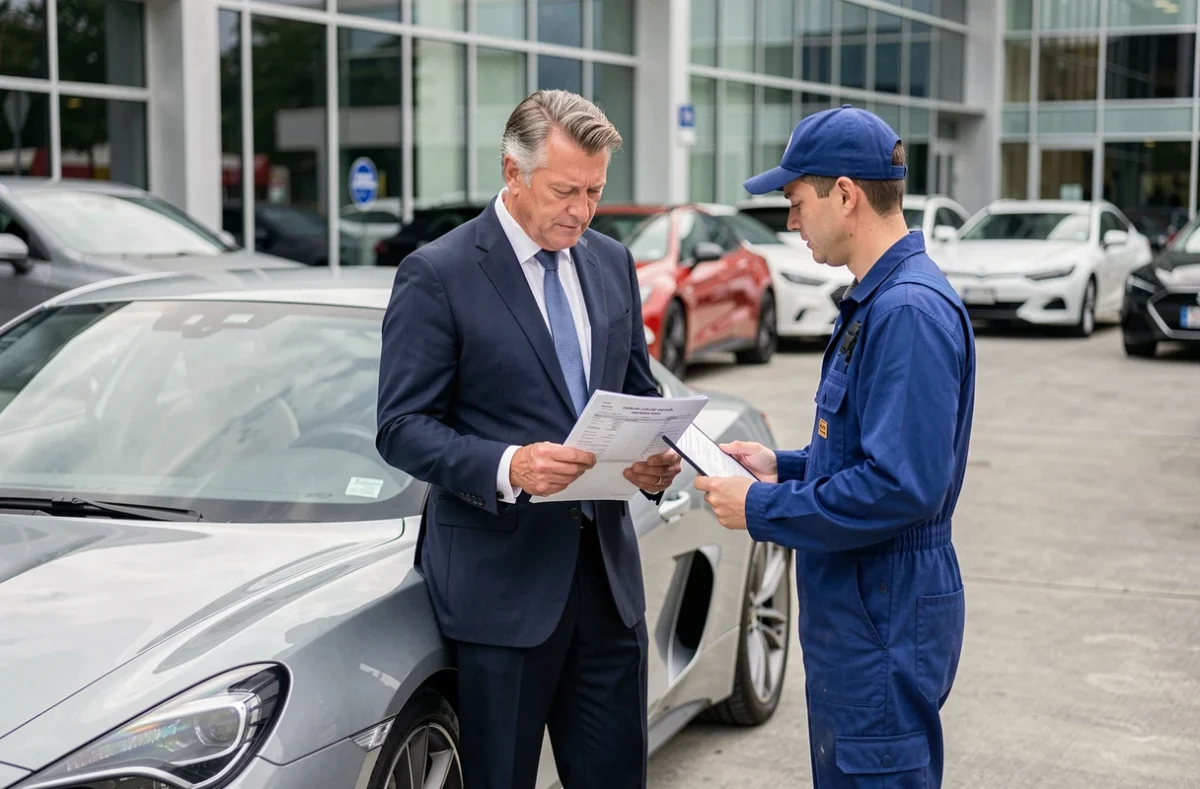
The maintenance of a Porsche 997 is always a major concern for someone about to make this purchase. Although Porsche has a very good reputation for the durability of its vehicles, each visit to the dealership can be costly, and it is necessary to anticipate the recurring costs associated with maintenance and known issues.
Porsche 997 Maintenance: Reliability Black Spots
Reliability Black Spots
As a reminder, the Porsche 911 type 997 range is composed as follows, from least to most powerful:
Phase 1 (2004-2008):
— Carrera, 3.6-liter model with 325 horsepower. — Carrera S, 3.8-liter model with 355 horsepower. — GT3/GT3 RS: 3.6-liter models with 415 horsepower. — GT2, 3.6-liter model with 530 horsepower. — Turbo, 3.6-liter model with 480 horsepower.
Phase 2 (late 2008 — ongoing):
— Carrera with 3.6 liters for 345 horsepower. — Carrera S with 3.8 liters for 385 horsepower. — Carrera GTS, 3.8-liter model with 408 horsepower. -GT3 /GT3 RS /GT3 RS 4.0: 3.8 models with 435, 450, and 500 horsepower. — Turbo /Turbo S, a 3.8-liter with 500 and 530 horsepower. — GT2/GT2 RS a supercharged 3.6 liters with 530 and 620
Overall, we can reassure owners of any of these models that they are very reliable over time.
Whether mechanically or in terms of market value, the Porsche 997 remains very good, and its interior is still impeccable despite the years.
However, recurring negative points have been recorded on certain models of the Porsche 997.
Negative Points on the Porsche 997
The most common problem is the flat 6 of the Porsche 991 type 997 Carrera and Carrera S phase 1. This weakness of the flat 6 is very damaging and can lead to engine failure. The Carrera S is more sensitive to this weakness, as it is less lubricated, causing the flat 6 sleeves to scratch and deform.
Equally important, the camshaft bearings are fragile, and in the event of failure, they can cause significant damage to the top of the engine. A secondary shaft bolt is also known to fail, which can lead to severe damage.
Recurring on the Porsche, the spinnaker seal is also something to watch closely. It is located between the engine and the gearbox, and it can lead to leaks and cause damage.
There is nothing noteworthy in the transmission of a Porsche 991 type 997, except for a few isolated cases of transmission cable failure on the manual gearbox. The Tiptronic gearbox of the Porsche 997 is more reliable and less expensive, but the sensations are not the same. The best automatic model remains the double-clutch Porsche 997 PDK released at the end of 2008, quite rare on the second-hand market.
Finally, when buying a Porsche 997, no one is safe from a careless seller who may have mistreated their vehicle. Maintenance at a Porsche garage is a primary guarantee of safety. A visit for a complete vehicle assessment seems to be the best security, even if it cannot truly eliminate any danger.
Overall, the GT3, Turbo GT2, and Porsche Phase 2 models are more robust.
How much does it cost to maintain a Porsche 997 per year?
If we refer to the Porsche maintenance guide, you will need to do:
- Engine oil and oil filters should be changed every 30,000 km or 2 years, costing around 300 euros.
- Spark plugs, every 90,000 km or four years.
- Air filter elements, every 60,000 km, 6 years for phase 1 and every 90,000 km and 6 years for phase 2.
- Brake fluid, every 2 years.
- Tires should be changed every 20,000 km (more if used on track). It will cost 290 euros for the front and 480 euros for the rear (installation included).
- Brake pads (depending on vehicle treatment) 450 euros for the front, 390 euros for the rear, with 1200 euros and 970 euros respectively for changing the discs and pads.
- A clutch will cost you 1,800 euros.
- Air conditioning, every 80,000 km.
Porsche groups these services into packages. Thus, small maintenance every 30,000 km or every 2 years and 60,000 km or 4 years, phase 2 for large maintenance, costs 425 euros and 1,200 euros respectively.
For this, you can add the consumption of 11 liters in mixed consumption (advertised consumption and variable depending on the models).
Quite reliable, opt for a Porsche 997 phase 2 (after late 2008) which will have a much more robust design. The Porsche 997 does not cost that much to maintain, especially if you have a vehicle that, when well maintained, will be the clearest of its time on the roads. Of course, owning a Porsche 997 is an additional cost, but without premature wear of certain parts that a complete assessment in a Porsche garage can detect.
How much does insurance for a Porsche 997 cost?
It is difficult to announce a price without knowing the driver’s profile as well as the use and version of the vehicle. To get a first estimate, feel free to request our services!
Tag: maintain a porsche